The Show Notes #36: ¡Felíz El Día y Mes de la Etnia Negra de Panamá!
The Show Notes #36 highlights MiLB/MLB's retired and active Afro-Panamanians. May is the official Black History Month of Panama and May 30th is the Official Black Ethnicity Day of Panama.

26 years ago, the Republic of Panama’s legislative assembly ratified “Law 9 of the Year 2000”, which declared May 30th to be the country’s official Black Ethnicity Day. In Spanish, this day is known as “La Dia de la Etnia Negra de Panamá.” The isthmus nation that was formerly a province of Colombia until 1903 additionally celebrates the cultural contributions and prominent impact of its substantial Black population throughout the month of May as Panama’s Black Ethnicity Month.[1] The idea that there are very few self-identifying Black people throughout Latin America is still alive and well across the United States despite the fact that close to three out of every ten people in Panama self-identify as Black, per Panama’s 2023 census recorded by the Instituto Nacional de Estadística y Censo, the Republic of Panamá’s official department for recording official censuses and compiling relevant statistics.[2] The movement of more than 100,000 Black people from Trinidad & Tobago, Jamaica, Barbados, Haiti, and other Francophone and/or Anglophone Antillean island nations during the last two decades of the 1800s and the first four decades of the 20th century is the Panamanian equivalent of the First Black American Great Migration. Most of these individuals congregated in the urban areas of Panama City and Colón.
Eduardo Campbell-Bethancourt & Armin Langer’s 2026 article on grassroots and government-affiliated Afro-Panamanian political organizations using the various mechanisms of political outcomes to secure institutional representation and de jure human rights from the Panamanian government during the 20th and 21st centuries contains a treasure trove of information pertaining to the existence and history of self-identifying Afro-Descendants in Panama.[3] These political organizations include Le Secretaria Nacional para el Desarrollo de los Afropanameños, Consejo Nacional de la Étnia Negra, El Congreso del Negro Panameño, Sociedad de Amigos del Museo Afroantillano de Panamá, Unión Nacional de Panameños, Asociación de Profesionales, Obreros y Dirigentes de Ascendencia Negra, and Reivindicadora del Negro Panameño.
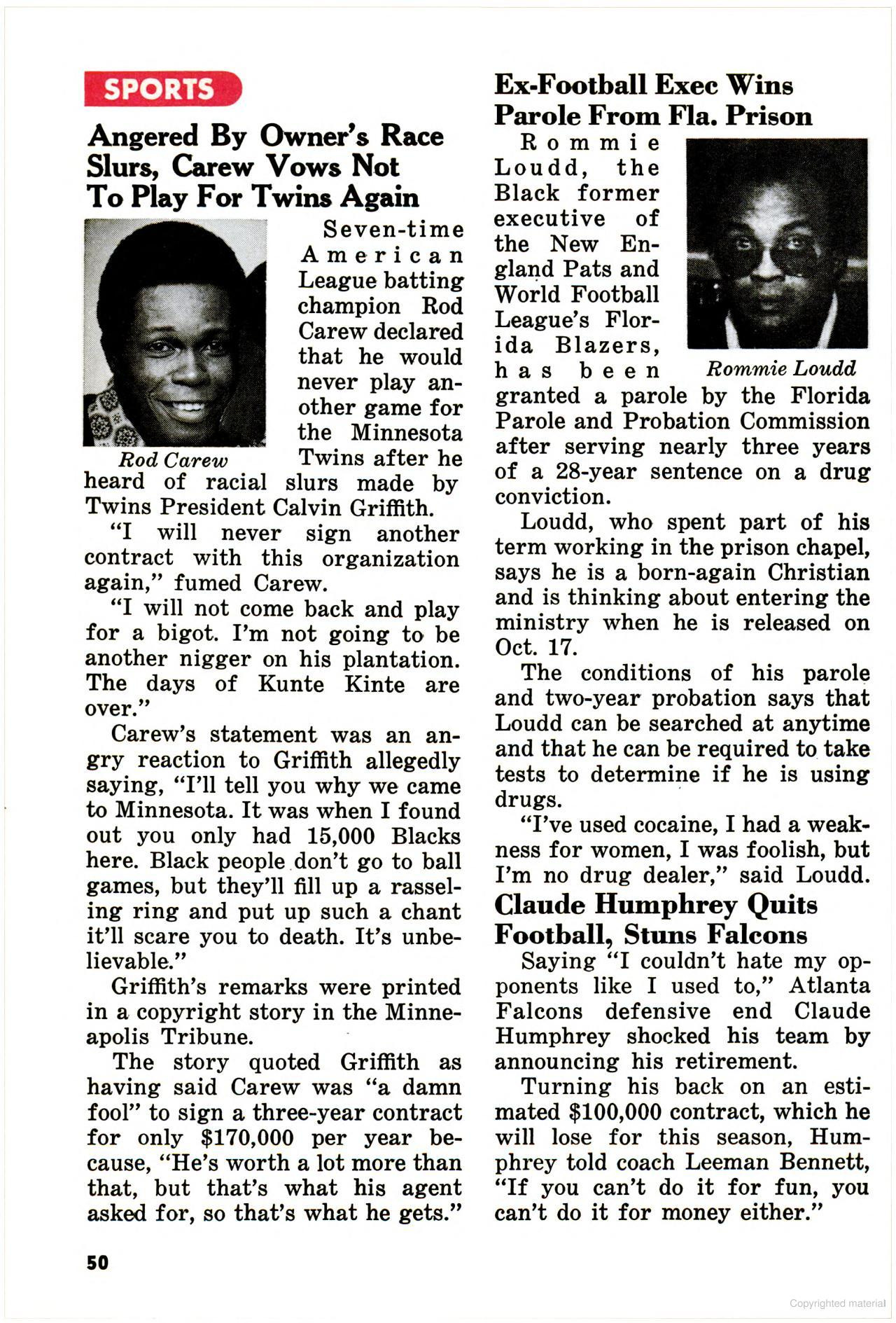
The very first headline in the “Sports” section of the Black American weekly print magazine JET from October 19th, 1978 reads “Angered By Owner’s Race Slurs, Carew Vows Not To Play For Twins Again.”[4] The article describes the initial events that eventually led to Trinidadian-Panamanian second baseman Rod Carew getting traded to the California Angels of Anaheim from the Minnesota Twins in February 1979 after signing a contact extension in the midst of his career peak. Panama is one of the many Latin countries that has had its contributions to the African diaspora’s relationship with baseball erased within the United States since the Civil Rights Movement’s conclusion during the early 1970s. There is not a more fitting time to high some of the active and retired Afro-Panamanians who have worn Negro Leagues and/or MiLB/MLB uniforms. Happy Panamanian Black Ethnicity Day and Month to all the Afro-Panamanians across the globe!
Notable Retired & Deceased Afro-Panamanians of the Negro Leagues & MLB
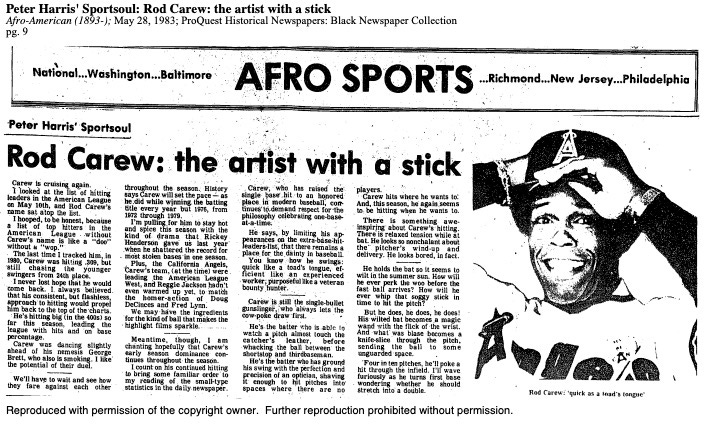
There is no other appropriate way to start than with the aforementioned Trinidadian-Panamanian Rod Carew, who is far and away the greatest Black baseball player to ever emerge from Panamá. He won the AL Rookie of the Year Award in 1967 and was the recipient of the AL MVP Award in 1977. He was inducted into the Baseball Hall of Fame on his first ballot in 1991. The 18x All-Star led MLB in batting average four times and led the AL in batting average another three times. He has ten full seasons with a batting average above .330, and another five seasons with a .300 average or higher. He swiped 353 bags during his illustrious 19-year-career and accumulated 3053 total hits on a .328/.393/.429 slash line, drawing 1018 walks and striking out 1028 times across 10550 plate appearances.
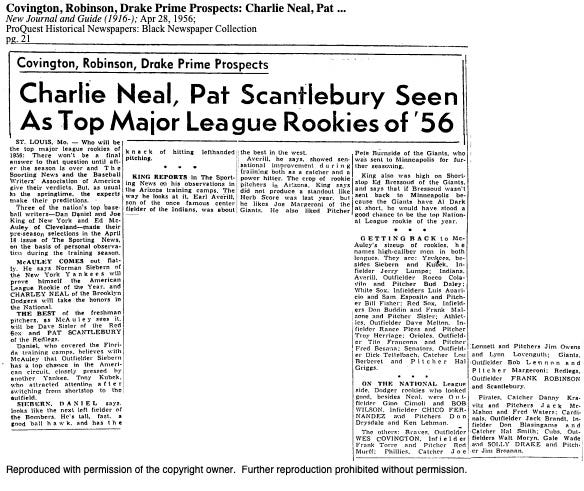
Unbeknownst to many, there were a handful of Afro-Panamanians from Antillean and/or Afro-Latinx backgrounds who played in the Negro Leagues. The most prominent of these individuals was left-handed starting pitcher/corner outfielder Patricio Scantlebury. He was the second Panamanian to wear a MLB uniform, doing so at 38 years old after five great years with the New York Cubans. He threw 24 complete games during his time in the Negro Leagues, which was good enough to get him noticed by MLB scouts. He only made six appearances for the Reds during the 1956 season, posting a 6.63 ERA. He logged impressive numbers in the Triple-A level International League (IL) from 1957 to 1961, which was crowded with talented veterans from the Negro Leagues such as the legendary Satchel Paige, Cleveland Buckeyes slugger Luke Easter, a speedy switch-hitting center fielder named Sam Jethroe, Jamaican-Cuban catcher Ray Noble, and Black American starting pitcher Bill Greason, one of the very few Negro Leagues veterans who is still alive. There were also young Black players on their way to the majors competing in the IL such as 2x World Series MVP Bob Gibson, longtime Phillies center fielder Tony González of Cuba, Bahamian outfielder Tony Curry, Afro-Cuban shortstop Leo Cardenas, and Black American swingman Al Johnson. Other Afro-Panamanians who made appearances in the Negro Leagues include Vibert Clarke, Frank Austin, Archie Brathewaite, Clyde Parris, and Leon Kellman.
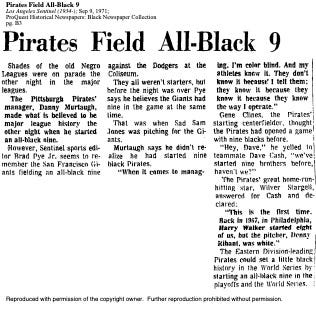
Relief pitcher Humberto Robinson was the first very Panamanian to establish himself in the majors. He appeared in 102 games across five seasons in MLB and also participated in the Panamanian Winter League. Robinson settled in New York City after his playing days concluded and lived there until his passing in 2009 at the age of 78. Catcher Manny Sanguillén was a key cog of the Pittsburgh Pirates during the team’s Golden Era in the 1970s alongside Hall of Fame inductees Willie Stargell and Roberto Clemente. The Colón native had a longstanding rivalry with Cincinnati Reds catcher Johnny Bench that started when they were in the minor leagues together and continued as the Pirates and Reds repeatedly clashed in the postseason. Sanguillén was a free-swinging right-handed batter who accumulated 1500 hits and recorded a batting average higher than .315 in three different seasons. The three-time All-Star was the starting catcher in the all-Black lineup that took the field for the Pittsburgh Pirates on September 1st, 1971. Sanguillén was best friends with Afro-Boricua Roberto Clemente and narrowly avoided being involved in the tragic plane crash that took Clemente’s life because of a malfunctioning car. Afro-Panamanians Rennie Stennett and Omar Moreno also contributed to the Pirates success during the 1970s. Stennett was a Trinidadian-Panamanian utility-man who once went 7-7 in a nine-inning game and Moreno was one of the most prolific base stealers of the 1970s.
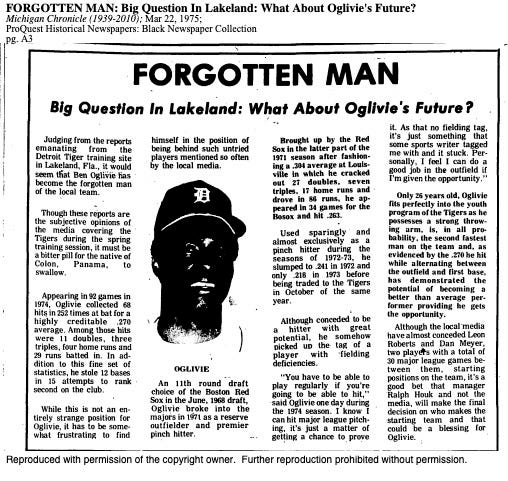
Wayne State University alumni Ben Oglivie found a way to carve out a 16-year-career and made three All-Star appearances despite struggling during his first three seasons with the Boston Red Sox. He did not get a chance to be a full-time player until he was 29, seven seasons into his career, and on his third team. The left fielder from Colón is the only Panamanian in the entire history of professional baseball to hit at least 40 home runs in an individual season. Known as the Philosopher-Home Run King, he had a reputation for being studious and articulate that followed him throughout his MLB career. The bilingual Jamaican-Panamanian studied at four different colleges after moving to the United States to live with his older sister and five older siblings in 1967 at 17 years old. Oglivie began coaching after his days as a player concluded, spending time in various organizations as a hitting coach and roaming instructor during the 1990s, 2000s, and 2010s.
Active Afro-Panamanian Minor Leaguers & Major Leaguers
Afro-Panamanian-American outfielder Enrique Bradfield Jr. was drafted by the Baltimore Orioles with the 17th overall pick of the 2023 MLB Draft after three standout years at Vanderbilt University. He was born and raised in Broward County, Florida and is currently assigned to Baltimore’s Triple-A affiliate. The switch-hitting center fielder has a chance to join an illustrious legacy, as there have been six different Black center fielders who have started at least two Opening Days in a Baltimore uniform. Paul Blair, Al Bumbry, and John Shelby patrolled center field at Memorial Stadium for nearly 20 consecutive seasons from 1965 to 1984. Trent Devereaux was the starting center fielder for the Orioles from 1990 to 1994. 5x All-Star and 4x Gold Glove winner Adam Jones was Baltimore’s full-time center fielder for twelve consecutive seasons before passing the baton to Cedric Mullins, giving the Orioles another 19 consecutive year stint with a Black center fielder. Bradfield Jr. was the starting center fielder for Team Panamá in the 2026 World Baseball Classic and should be a long-term fixture on the Panamanian national team for the next decade.
Panama City native Ryan Burrowes was signed by the Chicago White Sox during the 2022 signing period for international amateur prospects and got a $75,000 dollar signing bonus. The 21-year-old Afro-Panamanian of Antillean descent is a toolsy, right-handed hitting super-utility prospect with sound on-base skills and competent base running acumen. Eduardo Tait is a left-handed hitting catcher in the Minnesota Twins organization who was one of two prospects sent from Philadelphia in the Jhoan Duran trade. Already at the High-A level, the 19-year-old’s calling card is his raw power and strong throwing arm. Time will tell if he can develop enough to stay behind the dish and whether he has the ability to be a competent catcher. 18-year-old catcher/first baseman Jhojan Downer was signed by the San Diego Padres during the 2024 signing period and has went .357/.538/.429 across 12 games in the 2026 ACL.
References/Further Reading
[1] https://launiversidad.up.ac.pa/node/1601
[2] https://www.citypopulation.de/en/panama/admin/?mode=userdef&cols=E_AFR&color=123.58208955223883&map=osm_dlr&opacity=0.8
[3] https://doi.org/10.1080/17442222.2026.2624279
[4] https://books.google.co.ls/books?id=br8DAAAAMBAJ&lpg=PA1&pg=PA50#v=onepage&q&f=false
[5] https://www.baseball-reference.com/boxes/PIT/PIT197109010.shtml