The modern-day Dominican Republic’s African-American, Francophone Afro-Caribbean, and Anglophone Afro-Caribbean ethnic enclaves are some of the African diaspora’s more unique yet lesser known demographics in the Western Hemisphere, and they’re beginning to produce professional baseball players at a noticeable rate. Notable Dominican players who hail from these three ethnic enclaves include Fernando Rodney, Mariano Duncan, Rafael Devers, Alfonso Soriano, Miguel Sanó, and José Offerman.
There are individuals of African-American descent throughout the Samaná Province and in certain major urban areas of the Dominican Republic because of the Haitian Emigration Project that existed from 1824-1826. The Samaná-American enclave speaks a unique creole known as Samaná English (SE) that combines Dominican Spanish and antiquated Black American English. A member of the Atlantic Creole language family, SE is a sister language of the Bahamian dialect and the Gullah language of the Southeast United States (Georgia/Florida/The Carolinas). SE is also a cousin language of the Afro-Colombian Palenquero language, the Jamaican-Nicaraguan-Miskito Miskito Coast Creole, and the Jamaican-Costa Rican creole known as Limónese or Mekatelyu.
The Radney Brothers - Adriel and Chariel
The Dishmey Clan - Samil, Halan, Eliazar, Christopher, & Brandol
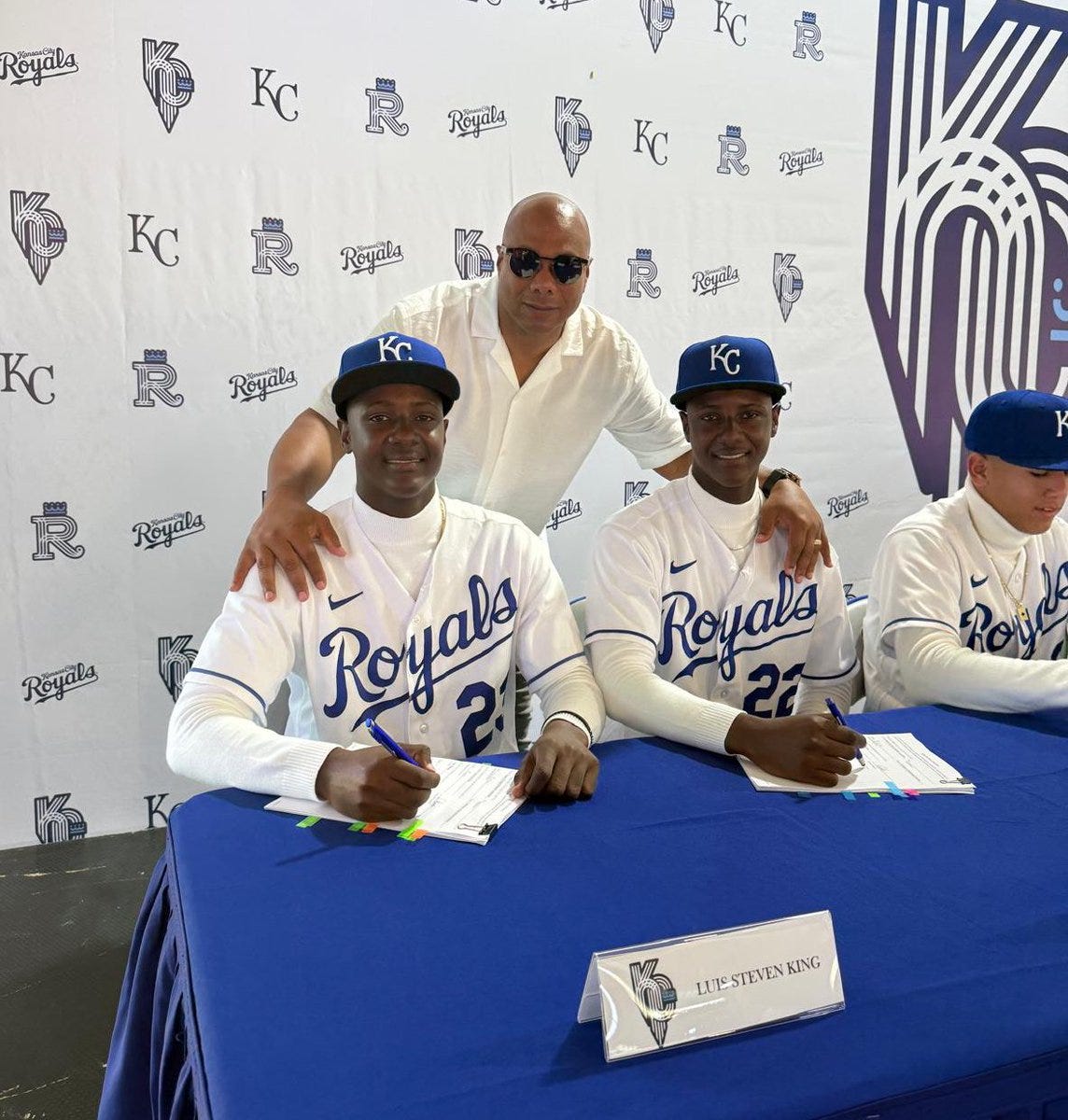
The King Twins - Luis Ramón and Luis Stephen
Wenderlyn King
Felix Cotes
Justin Barry
Jose Anderson
Gabriel Jackson
Jeyson Horton
Known locally as Cocolós, the Anglophone Afro-Caribbean immigrants who moved to the Dominican Republic from Turks & Caicos, Curaçao, the US & British Virgin Islands, and other smaller Caribbean islands are mostly concentrated within the Puerto Plata and San Pedro de Macorís municipalities, where they use English as a second language to accommodate the large number of American tourists who frequent the two areas.
Wilian Bormie
Jemone Nuel
Edgar Walker
Derek Bernard
Victor Simeon
David Beckles
Gregori Louis
Mervin Fell
Dawel Joseph
Elison Joseph
Bernard Mack
Miguel Welch
Ezequiel Melbourne
Rickey Moneys
Luis Thomas
Also referred to as Cocolós, the overwhelming majority of Haitian-Dominicans hail from La Romaná and San Pedro de Macorís. While many of Haitians from the DR, The Bahamas, and Cuba in MiLB hide their heritage and change their names because of rampant anti-Haitianism within baseball, there are more active Haitian-Dominicans in the upper echelons of professional baseball than ever before.
Jhonkensy Noel
Felnin Celesten
Yoniel Curet
Bernardo Doc
Anyelo Jean-Baptiste
• Caribbean Crossing: African Americans and the Haitian Emigration Movement: https://www.si.edu/object/caribbean-crossing-african-americans-and-haitian-emigration-movement-sara-fanning%3Asiris_sil_1076572
• Samaná English: African-American Language in the Dominican Republic: https://www.google.com/books/edition/Saman%C3%A1_English/APJLEQAAQBAJ?gbpv=0&hl=en
• Disruptive Silences: The AME Church and Dominican-Haitian Relations: https://www.jstor.org/stable/10.5325/jafrireli.5.1.0001
• On the Influence of British/American English in the Dominican Society/A Revisited Edition: https://nsuworks.nova.edu/fdla-journal/vol9/iss1/19/
• A Merging of Two Cultures: The Afro-Hispanic Immigrants of Samana, Dominican Republic: https://www.jstor.org/stable/23053961
• Preserving Black American History Through Song in the Dominican Republic: https://www.nytimes.com/2018/11/30/travel/preserving-black-american-history-through-song-in-the-dominican-republic.html
• “Americans” in Samaná: https://www.jstor.org/stable/25611688
• Copula Absence in Samaná English: Implications for Research on the Linguistic History of African-American Vernacular English: https://www.jstor.org/stable/455493
• Obsolescence in the English Perfect? Evidence from Samaná English: https://www.jstor.org/stable/455607
• Black Protestants in a Catholic Land: The AME Church in the Dominican Republic 1899–1916: https://www.jstor.org/stable/24713938
• Spirituals from the “American” Colony of Samana Bay, Santo Domingo: https://www.jstor.org/stable/535019?seq=1
• America’s Conservatory: Race, Reconstruction, and the Santo Domingo Debate: https://www.jstor.org/stable/41508911
• Haitians, “Cocolos”, and African Americans: Early Authors of Contemporary Afro- Dominican Literature: https://www.jstor.org/stable/40986169
• The Death of the Mother of Victoria Green: https://www.jstor.org/stable/44511932
• How Black English Past Got to the Present: Evidence from Samaná: https://www.jstor.org/stable/4167975
• The Presence of African Languages in Latin America: https://www.jstor.org/stable/resrep72889.51
• An Epidemic of Negrophobia: Blackness and the Legacy of the US Occupation of the Dominican Republic: https://www.jstor.org/stable/24803023
• Playing Ball in a Black and White “Field of Dreams”: Afro-Caribbean Ballplayers in the Negro Leagues, 1910-1950: https://www.jstor.org/stable/2717497
• Haitian-Dominican History and the 1937 Haitian Massacre: https://www.jstor.org/stable/10.3998/mpub.12278109.5
• Forgotten Migrations from the United States to Hispaniola: https://scholarworks.umb.edu/trotter_review/vol19/iss1/8?utm_source=scholarworks.umb.edu%2Ftrotter_review%2Fvol19%2Fiss1%2F8&utm_medium=PDF&utm_campaign=PDFCoverPages
• Not a Cockfight: Rethinking Haitian-Dominican Relations: https://www.jstor.org/stable/3185037?seq=1
• Genocide Next Door: The Good Neighbor Policy, the Trujillo Regime, and the Haitian Massacre of 1937: https://www.jstor.org/stable/24913419
• The United States and the Trujillo Dictatorship, 1933-1940: The High Price of Caribbean Stability: https://www.jstor.org/stable/25611893
• Both Sides of the Massacre: Collective Memory and Narrative on Hispaniola: https://www.jstor.org/stable/44029461
• “How Lucky for You That Your Tongue Can Taste the ‘r’ in ‘Parsley’”: Trauma Theory and the Literature of Hispaniola: https://www.jstor.org/stable/41350920
• Left Out: Afro-Latinos, Black Baseball, and the Revision of Baseball’s Racial History: https://read.dukeupress.edu/social-text/article-abstract/27/1%20(98)/37/33580/Left-OutAfro-Latinos-Black-Baseball-and-the?redirectedFrom=fulltext
• Picturing “the Tightest Little Tyranny in the Caribbean”: The March of Time and a 1936 United States–Dominican Diplomatic Crisis: https://www.jstor.org/stable/10.2979/filmhistory.29.4.04
• Early Afro-American Presence on the Island of Hispaniola: A Case Study of the “Immigrants” of Samaná: https://www.journals.uchicago.edu/doi/abs/10.1086/JNHv72n1-2p33?journalCode=jnh
• Out at Home: https://www.espn.com/espn/feature/story/_/id/18900471/the-complicated-state-haitian-dominicans-mlb
• MLB’s Neocolonial Practices in the Dominican Republic Academy System: https://www.researchgate.net/publication/349188304_MLB’s_Neocolonial_Practices_in_the_Dominican_Republic_Academy_System

Big up, bro! Would love to read an article about that anti-Haitian sentiment in baseball development system.