The Show Notes #19: Josue De Paula Is in Pursuit of Greatness
Josue De Paula is the type of prospect who can suddenly break through and drastically shift the balance of power in the NL West in favor of the Dodgers as they duke it out with the Giants and Padres.

Author’s Note
Thank you to John Vicari, Great Lakes Loons Broadcast & Content Coordinator, for granting me access and arranging my interview with Josue De Paula. Without people like John in my corner, I would not have had the opportunity to tell the stories of individuals like Josue De Paula. Thank you to Los Angeles Dodgers prospect Josue De Paula for his time and the wonderful conversation that led to this article. It means a great deal that he trusts me with his story, and I am honored to share it with my audience. - Pat Ellington Jr.
Josue De Paula’s lanky 6’4’’ frame and thick Brooklyn accent would lead most people to assume he spends a lot of time on the basketball court, but the truth is he started playing baseball at the age of four and never looked back. “My dad loves baseball, so he introduced me to it. And ever since I played, I fell in love with it,” he said with a smile. “On my mother’s side, everyone plays basketball. I’m the first one to play a different sport.” The 20-year-old Dominican-African-American outfielder is a younger cousin of legendary NYC point guards Stephon Marbury and Sebastian Telfair on his mother’s side. He is eager to make a name for himself by representing his family on a new front.
New York City’s incredibly long history of producing professional baseball players has been overshadowed by its reputation as “The Mecca of Basketball” during the 21st century. Unbeknownst to many, the first documented baseball game between two professional Black teams took place in New York City in 1869. Suppose De Paula completes the arduous journey to the majors. In that case, he will join a group of Black MLB players from New York City’s five boroughs that includes Rod Carew, Marcus Stroman, Shawon Dunston, Willie Randolph, Dave Cash, Ken Singleton, Bobby Bonilla, and Tommy Davis.
“I believe there are a lot of good [baseball players] coming from New York. It gets overshadowed by other sports, and the weather doesn't help either. I always think about how [the Dodgers] used to be in Brooklyn. It’s fitting to have that connection. And I really like Dodger Blue, I think it looks good.”
By the time he was in middle school, the young Coney Islander had become one of the most promising position players for his age group throughout the entire East Coast. However, he didn’t realize he had the talent to play baseball professionally until his freshman year of high school. When the COVID-19 pandemic forced high school baseball programs across the United States to shut down in 2020, De Paula took a leap of faith and moved to the Dominican Republic on his own with a plan to find a trainer.
Choosing to become an international amateur free agent instead of maintaining his eligibility for the MLB Draft had plenty of incentives for the young New Yorker. It gave him more control over his career, as he could negotiate with all 30 teams on more equal terms instead of waiting to be selected. He would also be able to become a professional player a full calendar year earlier, as he met the minimum age requirement for the 2022 international signing period but was not eligible for the MLB Draft until 2023.
With his father pulling strings stateside, De Paula ended up at El Niche Baseball Academy in the Dominican capital of Santo Domingo after living with one of his uncles for a month. El Niche is a renowned academy that has produced All-Star-level talents such as Juan Soto and Elly De La Cruz. The Brooklyn native quickly established himself as one of the best corner outfielders in his age group on the Dominican amateur circuit, and teams began to take notice. He signed with the Dodgers on the first day of the 2022 international signing period for $397,000 dollars.
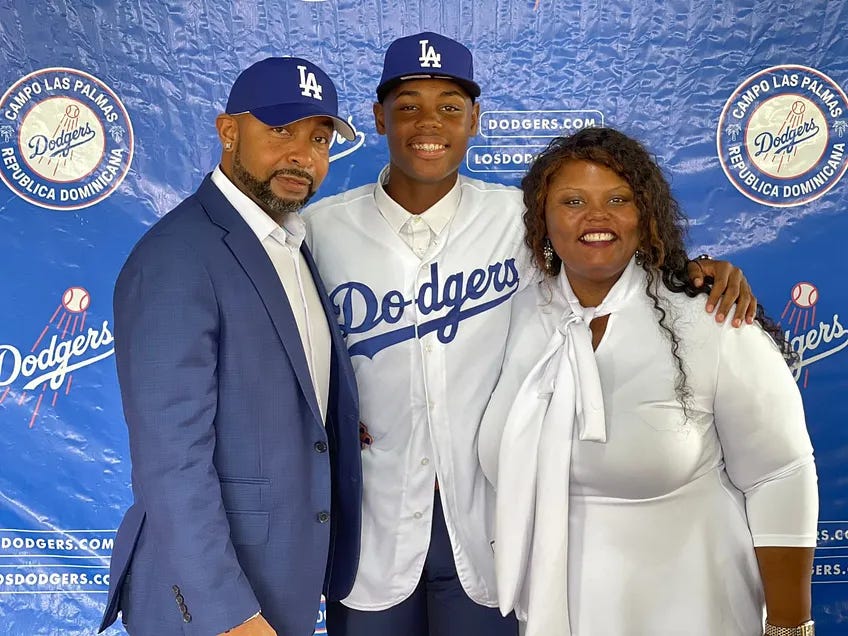
“I needed that challenge of living in a different country as a person and as a player. I feel like my abilities and talent rally started developing when I moved. I always had it, but it grew in [the Dominican Republic.] That’s when I felt like I was challenged and had competition. It's better weather. You've got more access to more fields. And over there it's just baseball, 24/7.”
