The Show Notes #18: Ernesto Martínez Jr. Is Fluent in the Language of Baseball
Ernesto Martínez Jr. has a five-tool profile that offers a ceiling similar to that of Freddie Freeman, Derek Lee, Jeff Bagwell, and Paul Goldschmidt in a highly athletic and mobile 6'6'' frame

Author’s Note
I would like to thank Ernesto Martínez Jr. for letting me interview him and tell his story to the world. I also owe 1000 thank yous to Cory Hilborne, Communications Manager of the Milwaukee Brewers Triple-A affiliate, Nashville Sounds, for dealing with my persistence while arranging the interview that led to the creation of this feature article. - Pat Ellington Jr.
Introduction
The island of Cuba has an extensive history of producing Black baseball players that stretches back to the late 1800s. Martín Dihigo and Luis Tiant II were amongst the many Black Cubans who competed in the Negro Leagues during the first half of the 1900s. Infielder Silvio Garcia was the first Black player approached by Branch Rickey to break MLB’s color line during the mid-1940s. Minnie Miñoso and Luis Tiant III were outspoken about being acknowledged as Black during and after their lengthy playing careers in MLB. African-American-Chinese-Cuban second baseman Tony Taylor played 19 seasons in MLB. Jamaican-Cuban Aroldis Chapman is one of the greatest left-handed relievers ever.
Haitian-Cuban first baseman Ernesto Martínez Jr. is the ideal candidate to join this esteemed group of Afro-Cuban baseball players. He plays the game with a high tempo, apparent joyfulness, and sense of competitive urgency that emits heavy Russell Westbrook vibes. Yes, the fact that he turns 26 next month and has yet to make his MLB debut is a gigantic red flag. This isn’t just another late bloomer who has a chance to have a handful of decent years doing typical first baseman stuff before fading into obscurity. He has a five-tool profile with a ceiling similar to that of Freddie Freeman, Derrek Lee, Jeff Bagwell, and Paul Goldschmidt in a highly athletic and mobile 6’6’’ frame. He also speaks four languages(Spanish, French, Haitian Kreyol, English) and has embarked on a path that stands out even amongst his other countrymen who have defected from Cuba to play in MiLB and MLB.
The Holguín Globetrotter’s Origin Story
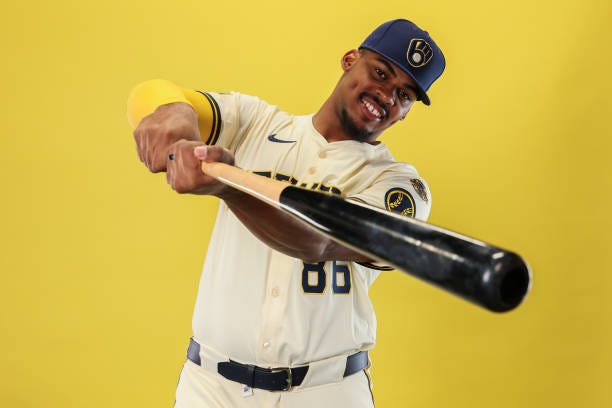
Ernesto Martínez Jr’s fluency in the language of baseball has enabled him to use his bat as a passport that has taken him across the world. He was born and raised in Holguín, Cuba, as the only child of two professional athletes of Haitian descent. His father was a longtime catcher in the Cuban National Series(CNS) who later defected to play in France, and his mother was a professional volleyball player in Cuba.
He played in his first international tournament at 12 years old and was one of the cornerstones of Cuba’s national teams for teenagers during the mid-2010s. In those tournaments, he established a reputation as a prolific two-way player against the world’s best baseball players in his age group. He followed his father across the Atlantic Ocean and defected to France in July 2014, just one month after turning 15. He trained and studied at Pôle France Baseball Academy in the South of France.
After watching the 6’6” left-hander throw in France and seeing his immense potential, former Cy Young Award winner Eric Gagné agreed to become Martínez Jr.’s pitching coach under the condition that he give up being a two-way player. The retired big leaguer would also leverage his connections to help Martínez Jr. showcase his repertoire in front of scouts as his official representative.
Before departing for the United States from France to begin training, Martínez Jr. lived in Haiti with relatives to establish residency outside of Cuba and gain eligibility for a French passport in 2015. While he grew up listening to his mother converse with his aunts in Haitian Kreyol and understood some of the language, Martínez Jr. became fluent during his three months in Haiti. After receiving a French passport, he moved to Arizona to begin his training.
“I moved to Scottsdale, Arizona for nine months, and Gagné taught me some things. I was doing well in all of my tryouts. I had twenty-two teams interested in me, and then I got hurt.”
The left-hander impressed scouts with a lively fastball in the mid-90s and a Vulcan changeup that he learned from Gagné. He also learned to speak English using a Rosetta Stone application on one of the Gagné children’s tablets. During negotiations with teams to join the 2016 J2 Class, he sustained a severe injury to his throwing shoulder, which necessitated postponing his transition to MiLB by an entire year. He decided to move to the Dominican Republic in 2016 and sought a trainer to relearn how to hit and field after almost three years of solely being a pitcher.
“A friend of mine was training at [Fernando] Tatís Sr.’s place and took me there. I didn’t really know anything about him except that he played in the majors. He saw me hitting bombs and decided to take me under his wing. And then I became a hitter again.”
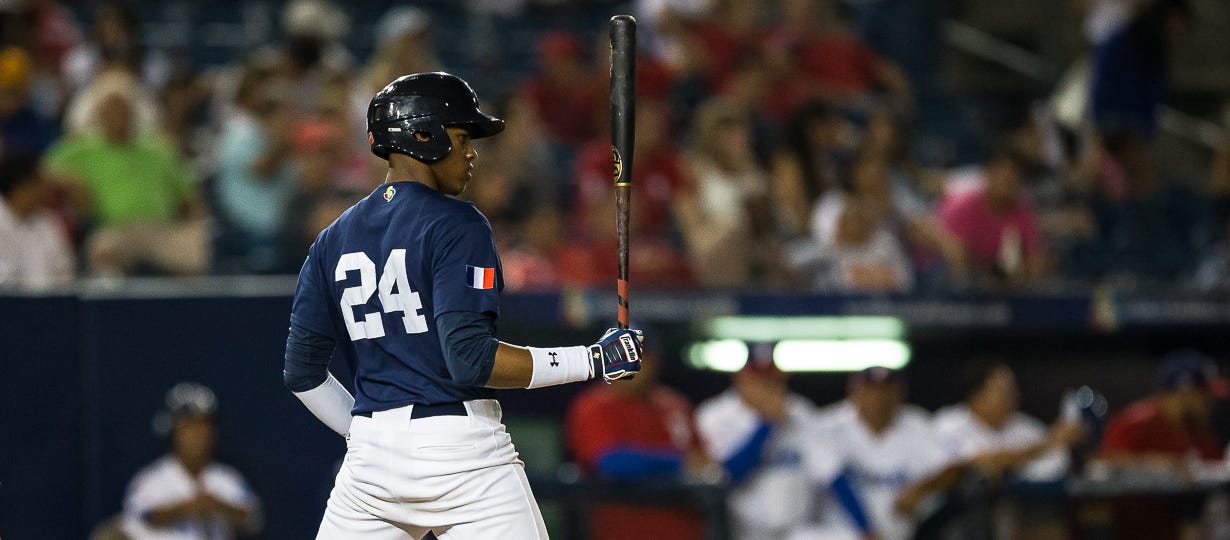
He trained under Fernando Tatís Sr. in San Pedro de Macoris for nine months. He drastically increased his value as a full-time first baseman in various showcases and tournaments throughout the Dominican Republic. He then dominated the amateur European circuit before becoming the youngest player to be included on a 25-man roster in World Baseball Classic history during the 2016 WBC qualifiers as a member of Team France. He played alongside his father and under legendary manager Bruce Bochy.
“[Bochy] is a great person. He taught me a lot about the game and about being a professional. Even though I did not spend much time with him because the pandemic canceled the WBC in 2020, he took me under his wing.”
Making the Long-Awaited Leap
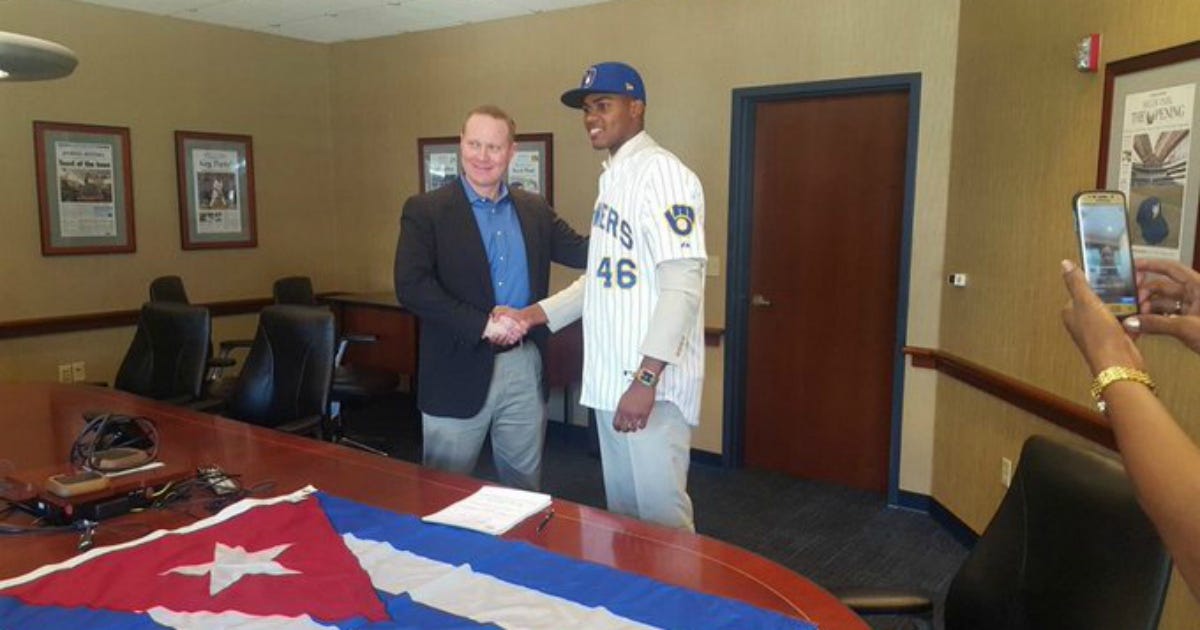
While most MLB front offices expressed immediate interest in him as a pitcher, it took much longer for Martínez Jr. to garner attention after transitioning to first base. Shortly after the WBC qualifiers concluded in the last quarter of 2016, he struck a deal with the Milwaukee Brewers in early 2017. Although he had minimal contact with scouts or front office members from the Milwaukee Brewers organization, they extended an offer he couldn’t refuse after orchestrating a trade to obtain additional international bonus pool money from the Baltimore Orioles.
Martínez Jr.’s professional career began during the 2017 MiLB season at 18. He competed in the Dominican Summer League before getting a late-season promotion to the Arizona Summer League. He repeated the ASL in 2018 and appeared in 35 games. During the 2019 season, he appeared in only 48 of 77 games with Milwaukee’s Pioneer League affiliate, posting a .262/.356/.445 slash line. He attributes his subpar performance during the first few years of his professional career to a lack of fundamentals.
“I didn’t understand certain things, whether big or small. For example, I didn’t know how to hit the ball up front. I only knew how to hit the ball hard. I didn’t understand that you have to apply mechanics to hitting. I didn’t pay attention to what my coaches were telling me because I was hard-headed back then. A lot of things were flying over my head in those days.”
Finally Turning the Corner
“El Espectáculo” secured more playing time and sustained success after the lockdown caused by the COVID-19 pandemic was lifted. Amid this newfound progress, he found it easier to be himself between the lines and in the clubhouse. His faith in God grew stronger, and he became more outgoing and upbeat off the field.
In 2021, he logged a .274/.370/.492 slash line across 311 plate appearances in 79 games with 15 doubles, 11 home runs, and 30 successful steals out of 34 total attempts. He played in only 28 games for the 2022 MiLB season after a wrist injury forced him to miss a substantial amount of time. He bounced back for the 2023 MiLB season with a .261/.345/.415 slash line across a career-high of 98 games played during a single season.
His breakout campaign finally arrived during the 2024 MiLB season. He posted a .284/.365/.466 slash line across a new career high of 110 games played with 30 doubles, 13 home runs, and 20 stolen bases. After resigning with Milwaukee as a minor league free agent after the 2024 season concluded, Martínez Jr. has continued to perform at an above-average level with Milwaukee’s Triple-A affiliate in 2025. He has a .270/.383/.427 slash line across 25 games with one double, two triples, and three home runs.
Diving in a Crowded Toolbox
Standing 6’6" and weighing 250 pounds, Ernesto Martínez Jr. has the lean build of a prototypical NBA small forward. His athleticism and mobility are rare for a position player his size. He is among the few individuals in his position group with five above-average tools in the minors or majors.
Despite being such a large individual, the Haitian-Cuban first baseman puts the bat on the ball at an above-average to borderline plus rate. He currently holds the nineteenth-lowest swinging strike rate out of 245 qualified players in Triple-A with at least 100 plate appearances. He rarely chases offerings outside the strike zone and teeters upon passiveness to some degree. He allows too many hittable fastballs to reach the catcher’s mitt in early counts instead of pulling the trigger. He compensates for this lack of aggression against fastballs with a knack for obliterating breaking pitches to all fields after putting together lengthy at-bats against opposing pitchers.
His remarkable ability to make contact for a hitter of his size stems from his unique stance, uncanny eye-hand coordination, and athleticism. The positioning of his hands lets him cover the strike zone with an optimal bat path. Martínez Jr. is forced to employ a long bat wrap because of his long arms, but he compensates for it with a sound feel for anticipating pitches by starting his swing early enough to get the bat around on time. He effectively utilizes his strong hands and robust core to generate elite bat speed consistently, a la Jazz Chisholm Jr. He consistently keeps his hands close to his chest when pitchers try to jam him on the inner third of the plate. He also possesses the requisite bat control to do enough damage against fastballs in the upper third of the zone.
He has top-of-the-scale power, but the caveat is that he does not hit flyballs at a high rate. He’s recorded exit velocities as high as 115 miles per hour and regularly produces exit velocities in the mid-90s. He sprays blistering line drives to all fields and knows how to get a well-placed groundball past the infield dirt for a base hit. It would not surprise me if he accrued doubles at a high rate, similarly to Freddie Freeman.
“I’ve always had [speed]. I was very limited in the beginning because they did not trust me that much. In 2021, my Low-A manager Joe Ayrault finally let me run, and I stole thirty bags in ninety something games. Prior to then, I really did not run.”
His high motor and baserunning prowess are also comparable to Freeman’s. He’s a slightly above-average runner with a long history of swiping bags at a high rate without getting caught. While he has struggled to swipe bags in Triple-A this year(1 SB/3 CS), it would not surprise me if Martínez Jr. accrued 100-200 stolen bases during his MLB career if he plays long enough.
“I learned how to play good defense by digging out bad throws from my friends. I studied taekwondo as a kid, which is why I know how to do the splits.”
He is one of the very few active players at the cold corner in MiLB or MLB who could win a Platinum Glove Award in the near future. He displays a plethora of creativity and flexibility when making picks in the dirt. He has become renowned for his ability to hit the splits like James Brown when attempting to secure outs. He’s also retained his arm strength from pitching, which allows him to contribute on relays and balls in play with a lot of traffic on the basepaths.
Conclusion
No single player in MiLB or MLB compares to Ernesto Martínez Jr. He possesses a frame and raw power that invite comparisons to Aaron Judge and James Wood. His bat-to-ball skills and athleticism as a full-time first baseman show shades of Freddie Freeman. He has the hands, range, instincts, and willingness to be a Don Mattingly-level defender at the hot corner. If MLB GMs could create first basemen in a laboratory, they would use Martínez Jr. as a template. His pursuit of an MLB uniform has taken him on a journey through five countries, forcing him to alter his identity as a baseball player significantly. After taking such a huge gamble, he’s on the verge of finding his way onto a 26-man roster in MLB and representing Cuba in the 2026 World Baseball Classic and 2028 Olympics.
Cool read.